
Ancient Inventions Timeline
Long before engines and electricity, people were already bending water, time and numbers to their will. This timeline lines up the breakthroughs behind the stories on Ancient Visionary, from the first carved megaliths to aqueducts, calendars and paper.
Dates this old are often approximate, so you will see plenty of circa marks. Each entry links to the source we checked it against.
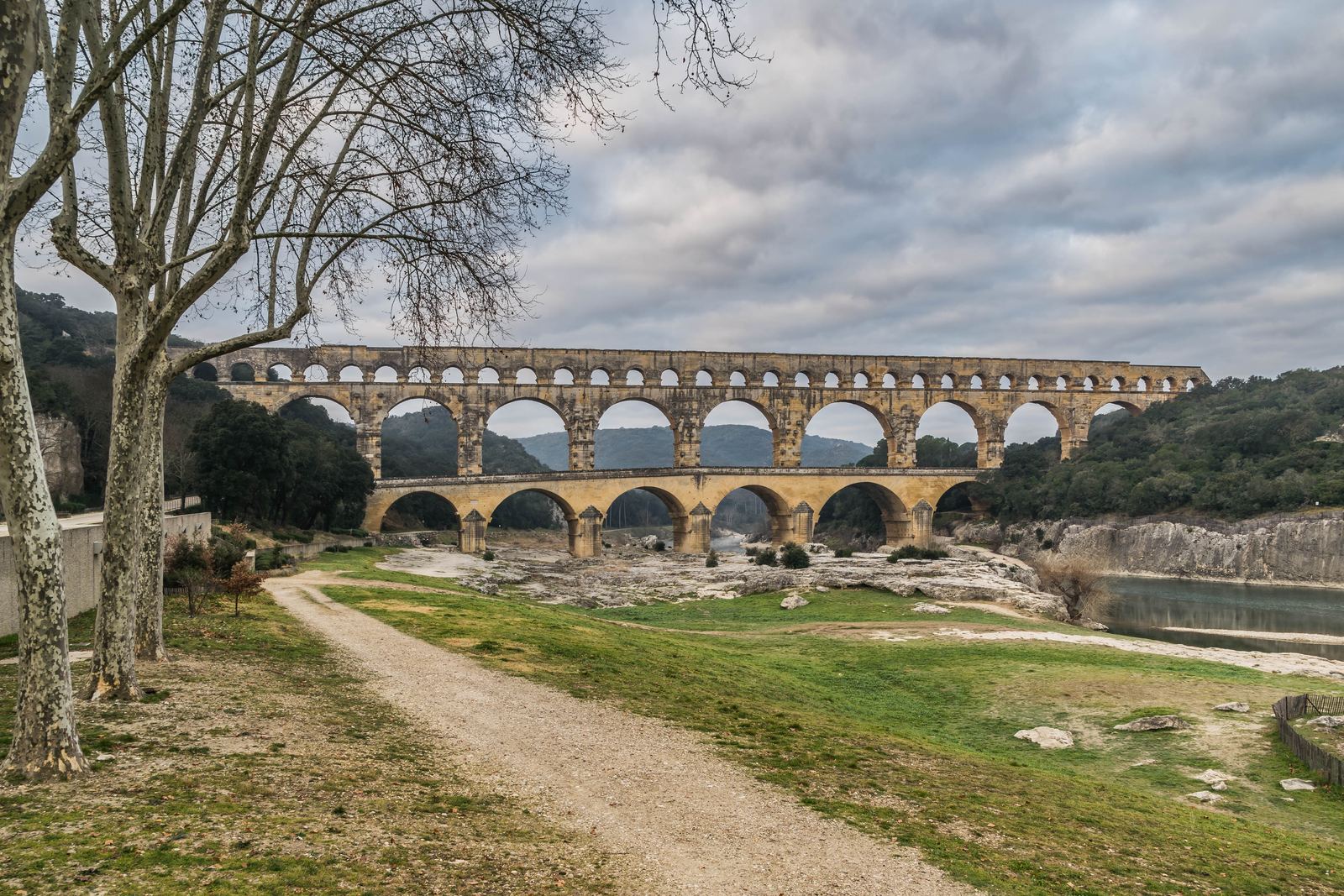
The Pont du Gard spanning the Gardon river in southern France: Krzysztof Golik, CC BY-SA 4.0
.jpg)
Ancient firsts, in order
- c. 9500 BCE
Göbekli Tepe rises in stone
People in what is now southeastern Turkey raise great carved stone pillars, among the oldest known megaliths, long before writing or the wheel.
Source: en.wikipedia.org - c. 3500 to 3400 BCE
Wheels start rolling
Evidence of wheeled vehicles spreads across Europe and the Middle East, following the potter's wheel of the 4th millennium BCE.
Source: en.wikipedia.org - c. 3300 BCE
Writing begins in Mesopotamia
Scribes at Uruk press signs into clay tablets. Cuneiform is the earliest known writing system.
Source: en.wikipedia.org - c. 1417 to 1379 BCE
The oldest surviving water clock
A stone water clock used at Karnak in Egypt, from the reign of Amenhotep III, measures time by the steady flow of water.
Source: en.wikipedia.org - Early 1st millennium BCE
Qanats tap hidden water
Ancient Iranians dig gently sloping tunnels that carry groundwater to the desert surface using gravity alone.
Source: en.wikipedia.org - 312 BCE
Rome's first aqueduct
Work begins on the Aqua Appia, a mostly underground channel about 16.6 km long that drops only about 10 m along its route.
Source: en.wikipedia.org - Early 3rd century BCE
The Library of Alexandria opens
The Ptolemies build a great library inside the Mouseion and set out to collect every book they can find.
Source: en.wikipedia.org - c. 250 to 220 BCE
The water screw appears
The earliest mention of the screw pump, a turning spiral that lifts water uphill, traditionally credited to Archimedes.
Source: en.wikipedia.org - c. 240 BCE
Eratosthenes measures the Earth
Comparing noon shadows at Alexandria and Syene, the Library's head estimates the planet's circumference at about 250,000 stadia.
Source: en.wikipedia.org - 2nd century BCE
The Antikythera mechanism
Greek craftsmen build a hand-cranked bronze gear device that models the sky and predicts eclipses, the oldest known analog computer.
Source: en.wikipedia.org - 36 BCE
An early Long Count date
Stela 2 at Chiapa de Corzo in Mexico carries one of the earliest known Long Count dates, a calendar that relies on zero as a placeholder.
Source: en.wikipedia.org - 1st century BCE to 1st century CE
Petra tames the flood
The Nabataeans dam the mouth of the Siq to steer flash floods away from their desert capital.
Source: en.wikipedia.org - 1st century CE
Hero's spinning steam ball
Hero of Alexandria describes the aeolipile, a sphere spun by jets of steam and the first recorded steam engine.
Source: en.wikipedia.org - 97 CE
Rome's water commissioner takes notes
Frontinus becomes curator of Rome's aqueducts and writes De aquaeductu, a detailed report on the city's water supply.
Source: en.wikipedia.org - 105 CE
Cai Lun improves paper
At the Han court, Cai Lun presents a better papermaking process using tree bark, hemp, old rags and fishing nets.
Source: en.wikipedia.org - c. 126 CE
The Pantheon's dome
Hadrian's rebuilt Pantheon in Rome is probably dedicated, crowned by a great dome of Roman concrete.
Source: en.wikipedia.org - 132 CE
Zhang Heng's seismoscope
Zhang Heng presents a device to the Han court designed to show the direction of a distant earthquake.
Source: en.wikipedia.org - 15th century CE
Inca roads and quipu
As the Inca state expands from 1438, it links its realm with a road network of about 40,000 km and keeps records on knotted quipu cords.
Source: en.wikipedia.org
Quick quiz: ancient inventions
Seven questions on the firsts above. Answers explained.
- Wikipedia: Göbekli Tepe
- Wikipedia: Wheel
- Wikipedia: Cuneiform
- Wikipedia: Water clock
- Wikipedia: Qanat
- Wikipedia: Aqua Appia
- Wikipedia: Roman aqueduct
- Wikipedia: Library of Alexandria
- Wikipedia: Archimedes' screw
- Wikipedia: Eratosthenes
- Wikipedia: Antikythera mechanism
- Wikipedia: Mesoamerican Long Count calendar
- Wikipedia: Siq
- Wikipedia: Aeolipile
- Wikipedia: Frontinus
- Wikipedia: Cai Lun
- Wikipedia: Pantheon, Rome
- Wikipedia: Zhang Heng
- Wikipedia: Inca road system
- Wikipedia: Inca Empire
Facts on this page were checked against these sources (updated Oct 4, 2026). Spot an error? Email hello@fireempireshop.com.